
Back in November, I wrote about three quiet shifts heading into 2026: Nova Scotia’s new approach to psychological injury claims, the federal pharmacare bill, and the rollout of the Canadian Dental Care Plan. Six months on, the picture is clearer. Some things landed the way you might expect. A few did not.
This is the May 2026 follow-up. Where each program actually sits today, what changed January 1 that you might have missed, and what to revisit before your next group renewal.
For the original November briefing, see Going Into 2026: How WCB, Pharmacare and the CDCP Are Reshaping Atlantic Employee Benefits.
Where the CDCP actually landed
By May 2026, the Canadian Dental Care Plan has enrolled over 6.3 million Canadians, with more than 4 million having already seen a dental provider under the program. The renewal season for existing members is open right now, running from April 15 to June 1, 2026. Members who do not renew by June 1 will see their coverage end on June 30.
For employers, the practical implication has not changed since November: the CDCP is income-tested and excludes anyone with access to private dental benefits through an employer plan, even if that employee chooses not to enroll. In other words, simply offering dental coverage as part of your group plan continues to disqualify your employees from the CDCP.
What has shifted is awareness. A meaningful share of employees, particularly part-time staff, contractors, and family members of low-wage workers, now know the CDCP exists and what it covers. Expect more questions at open enrollment about how the employer plan compares to what is available federally.
What to do:
- If you have employees in low-wage or part-time roles where dental is optional, build a clear one-pager that compares your plan to the CDCP. The comparison is almost always favorable to the employer plan for actual usage frequency, but employees often do not see that on their own.
- If you have been considering dropping dental from your plan as a cost-control move, the CDCP is not the safety net some employers assume it to be. Anyone earning above the household income thresholds (currently topping out around $90,000) gets nothing.
Pharmacare: who signed, who did not, and what it means here
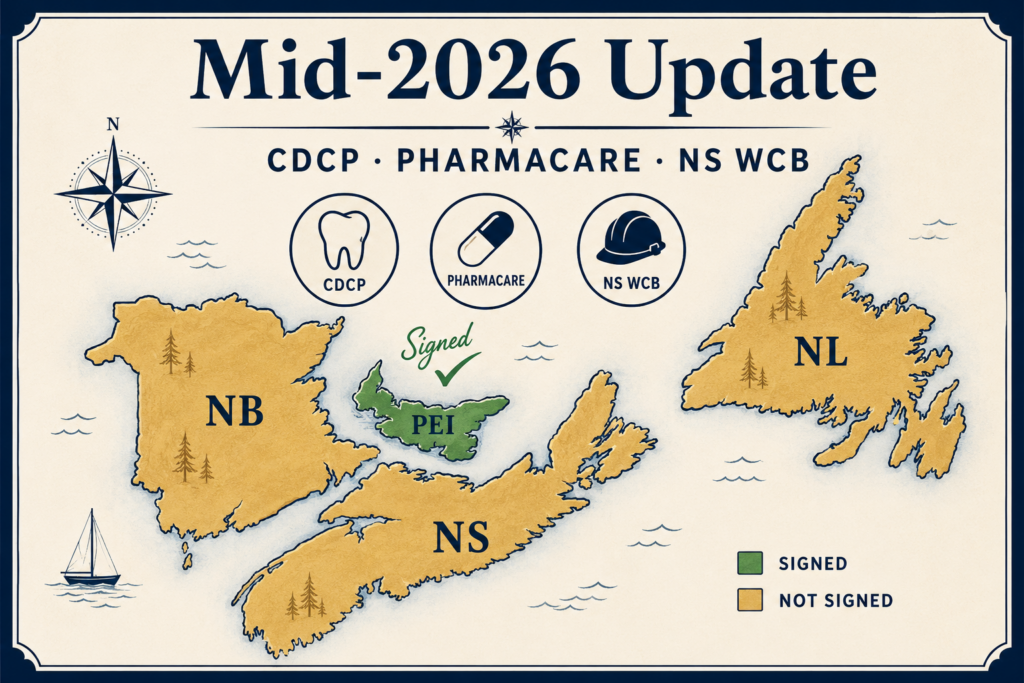
The federal pharmacare bill (Bill C-64) passed in 2024 and is now operating through province-by-province bilateral agreements. As of May 2026, four jurisdictions have signed and have funding flowing: British Columbia, Manitoba, Prince Edward Island, and Yukon. British Columbia’s program turned on March 1, 2026, with 100% first-dollar coverage for eligible contraceptives, Type 1 and Type 2 diabetes medications, supplies, and menopausal hormone therapy. Yukon and Manitoba are on similar timelines.
Nova Scotia, New Brunswick, and Newfoundland and Labrador have not signed.
For Atlantic Canada employers, that means your group drug plan is still the drug plan for your employees. Pharmacare’s first phase is meaningful in BC and PEI, but it has no current impact on a Halifax or Cape Breton workforce. The carriers are watching closely. If Nova Scotia were to sign in the next year, drug coverage in eligible categories would shift and renewal pricing models would update. As of now, nothing has changed operationally.
What to do:
- If you have employees in PEI specifically, you have one bilateral lane to think about. Diabetes medications and contraceptives are now federally covered there, which changes the marginal claim cost in those categories.
- For everyone else: business as usual. Your plan continues to do what it did. Watch the AllNovaScotia or Atlantic news cycle for any sign of a Nova Scotia signing decision. If it happens, we will cover it.
NS WCB: the changes that quietly went live January 1
Three significant Workers’ Compensation Act amendments took effect in Nova Scotia on January 1, 2026:
- The injury reporting window shrank. Employers must now report workplace injuries within two days, down from five. Late reporting risks compliance issues and slows the claim, which slows access to benefits and return-to-work planning.
- Employers receive functional ability information. When a worker is injured, the WCB now shares functional information directly with the employer (for example, lifting restrictions or duty limitations). This is meant to enable safer modified-duty assignments and faster, cleaner return-to-work programs. Only what is necessary is shared, but it is more than employers used to see.
- Appeal periods tripled. Workers now have 90 days to appeal a claim decision, up from 30. The practical effect for employers is that what looked like a closed claim three weeks ago may still get reopened. Build that lag into your reserve assumptions.
Gradual-onset psychological injury, which became compensable in 2024, remains in force. Claims have been climbing modestly through 2025 and into 2026, with the WCB making clear that everyday workplace stress does not qualify, but sustained exposure to harassment, bullying, or chronic significant stressors can.
What to do:
- Update your injury reporting workflow to assume a 48-hour deadline, not a 5-day one.
- If you do not have a documented modified-duty program, build one. The new functional information sharing makes this much easier to design honestly.
- If your group plan does not include short-term disability or an EAP/EFAP, those gaps are now more expensive than they used to be. Mental health claim trends are not slowing down.
What to revisit before your next renewal
A short list of things that have changed enough since November to warrant a fresh look at your plan and your messaging:
- Dental positioning. With CDCP awareness up, your dental coverage is more visible to employees as a comparison point. If you have not talked about your dental design recently, this is the year to do it. See our plan designs for the standard pooled options.
- Drug plan messaging in PEI. Only relevant if you have PEI employees, but if you do, the federal coverage of diabetes and contraceptives changes what your plan is for.
- STD, LTD, and EAP coverage. The combination of psychological injury claims at WCB, longer appeal windows, and a flat-or-rising mental health load means that disability and employee assistance coverage is doing more work than it was 18 months ago. Make sure they are sized right. See our plan add-ons page for the menu.
- Virtual care. With family doctor shortages still acute across Nova Scotia, virtual care is doing more of the heavy lifting on primary access. If it is not in your plan, this is the spring to add it.
- Reporting workflow. Two-day WCB reporting is a process change, not a benefits change, but it is the cheapest one to fix wrong.
Bottom line
Six months in, the federal programs have done what they said they would do. The CDCP is reaching millions, pharmacare phase one is running in a handful of provinces, the legislation is in place. But the impact on an Atlantic Canada group plan in May 2026 is smaller and more uneven than the November coverage suggested. Nova Scotia has not signed pharmacare. The CDCP does not reach employees who have employer dental.
What did change is local. Nova Scotia’s WCB reforms went live in January, and the practical effect on injury reporting, return-to-work, and disability claim trends is real.
If you want a quick benchmark on your current plan against current carrier pricing, pooled pricing is the fast lane. If you want a renewal-focused conversation, the custom quote path is built for that. Either way, it is a good year to revisit the plan you set up before any of this took effect.